In C++ Type casting is converting a value from one type to another.
there are two type of casting explicit and implicit.
Implicit Type Conversion
Implicit type conversion is performed automatically by the compiler whenever a value needs to be converted to a compatible type. It commonly occurs when:
- Performing operations on values of different data types.
- Passing arguments to functions expecting a different type.
- Assigning a value of one type to a variable of another compatible type.
#include <iostream>
using namespace std;

int main() {

    int i = 10;
    char c = 'a';

    // c implicitly converted to int. ASCII
    // value of 'a' is 97
    i = i + c;

    // i is implicitly converted to float
    float f = i + 1.0;

    cout << "i = " << i << endl
         << "c = " << c << endl
         << "f = " << f;

    return 0;
}
Explicit Type Conversion
Explicit type conversion, also known as type casting, is performed manually by the programmer to convert a value from one type to another.
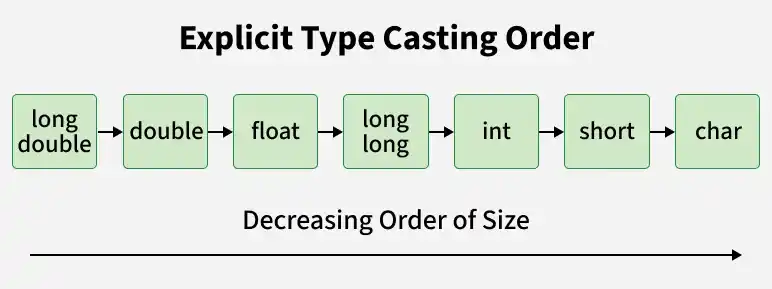
C++ provides dedicated cast operators that make conversions safer and more explicit.
Types of C++ Cast Operators
- static_cast – Performs standard compile-time type conversions.
- dynamic_cast – Performs runtime conversions in polymorphic class hierarchies.
- const_cast – Adds or removes const and volatile qualifiers.
- reinterpret_cast – Performs low-level reinterpretation of memory or pointer types.
reinterpret_cast
Is telling to the compiler “from this point on interpret this set of bits into this type T*”